Direct answers about LexFlow: how it works day to day, how clients reach their matter, how data is protected, which practice areas it covers, what integrates today and what is still on the roadmap.
Matters, activities, deadlines, intake and approved client updates live in one place instead of scattered across email, spreadsheets and memory.
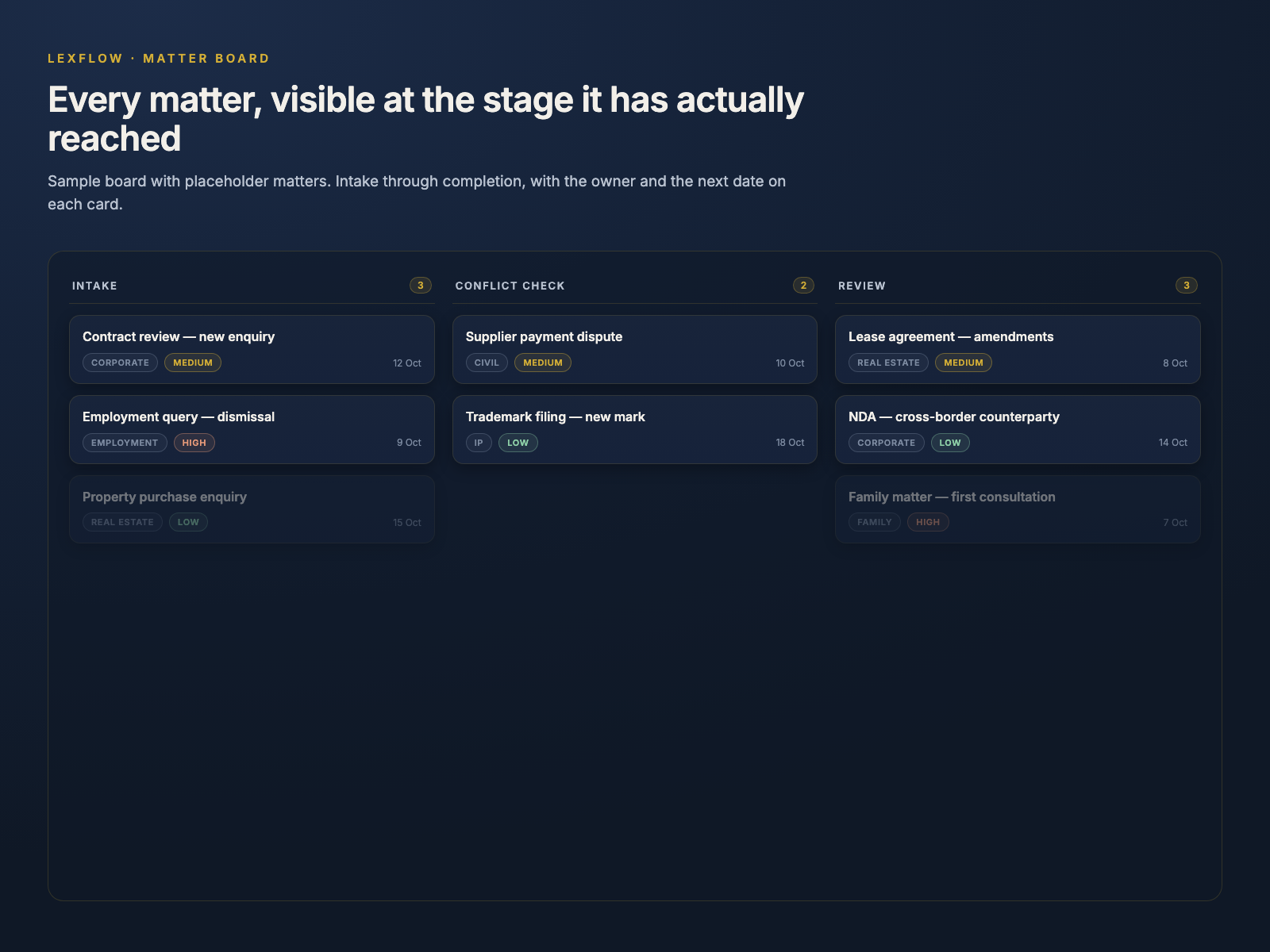
Kanban board for every matter
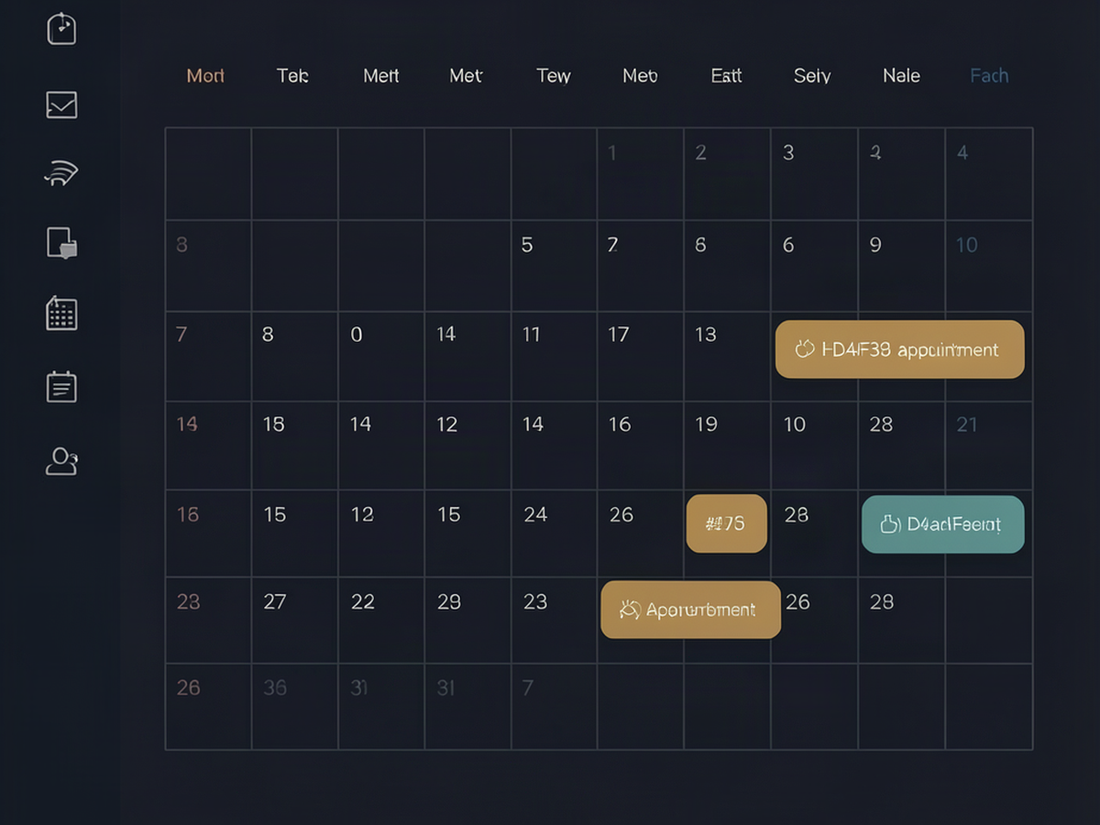
Notifications synced to the calendarThese figures come from an early pilot deployment and are shown as indications, not as measured outcomes. Methodology and formal measurement are in progress; treat them as directional until published.
Indicators from an early pilot. Formal measurement, methodology and sample size have not yet been documented for publication.
What the product is, who it suits, and what it costs.
LexFlow is a legal practice management platform that brings matters, activities, deadlines, client intake and client communication into one role-aware workspace. Records connect to each other: a matter holds its tasks, its dates, its intake information, the people involved, the documents and context attached to it, plus the approved updates a client is allowed to see. Lawyers, assistants, firm owners and the legal firm's client each see the part that is relevant to them.
LexFlow starts at the Organisation & Control tier for solo practitioners, with Steady Growth and Enterprise tiers scaling up in automation and AI capability. See the Pricing page for a full breakdown. Add-ons, including the AI Add-on, are quoted separately because scope varies by firm.
Yes. LexFlow is built exactly for firms of this size. It is structured enough to handle real matter volume, simple enough to need no IT department, and any team member can usually get up and running in under ten minutes.
The ten-minute figure is an onboarding estimate from our own setup work and is pending formal measurement.
Yes, LexFlow offers a no-obligation free trial with no credit card required.
Yes. Use the globe icon in the navigation bar to switch languages at any time. Additional languages are planned in upcoming versions.
What the legal firm's client actually has to do, on the devices they already own.
No. LexFlow runs entirely in the browser. Clients receive a link by email and open it on phone, tablet or desktop, with no download and no installation required. We test on current iPhone and iPad Safari and on Samsung and Android Chrome; if your client base uses something unusual, tell us during onboarding so it can be checked.
No. Each legal firm's client receives a unique token-secured URL that opens their personal matter page directly. A token-secured URL is a private access link generated for that specific matter, so the client can enter without registration or a password while access remains restricted to that link. Form submission or first contact does not by itself create a lawyer-client relationship.
The client opens their token-secured link and sees the approved information for that matter: the current stage, the latest approved update, the next milestone and anything the firm is waiting for. That lets the client track progress without having to contact their lawyer or a legal assistant every time. The lawyer keeps communication centred on the milestones that genuinely need a professional response, while routine and technical updates can be handled through automation.
How data is protected, what stays internal, and how we treat the standards we work towards.
Yes. LexFlow applies strong encryption and secure access controls designed to protect client information. In simple terms, encryption means data is scrambled so unauthorised people cannot read it, and secure access controls mean only the right people can open the right information. Client data in the LexFlow CRM is stored with bank-grade 256-bit encryption and zero-knowledge document storage, with SOC2-aligned security practices. Internal firm notes are never visible to clients.
See the glossary for what encryption, secure access controls and SOC 2 mean in plain language.
Data is managed in line with EU GDPR requirements and supported by recognised security and privacy management practices. Internal firm notes are never visible to clients, and each status page is accessible only through the unique token assigned to that matter. We protect the privacy of our customers and their clients using recognised standards as a point of reference. Formal certification against those standards is in progress.
Certification status: ISO/IEC 27001 and ISO/IEC 27701 certification is in progress, not yet held. SOC 2 is an auditing framework we align our practices with. These are reference points for how we build, not claims of completed certification.
LexFlow is designed with accessibility in mind: full keyboard navigation, visible focus states, minimum 44px touch targets, labelled form fields and motion that respects a reduced-motion preference. We do not currently claim conformance with a specific WCAG level; an independent accessibility audit is on our list before we state one.
Which areas of law LexFlow is set up for, and how intake is organised per area.
LexFlow supports firms working across multiple practice areas: Civil, Corporate, Family, Criminal, Real Estate, Intellectual Property, Immigration, Labour, Administrative, Constitutional, and Human Rights law. Intake forms can be configured by practice area so submissions are organised correctly from the start. Firms also run specialist work on LexFlow, including crimes against the person and against property, crimes against the public administration, financial and corporate crimes, tax crimes, drug-related offences, medical professional liability, tort liability, damage from things in custody, estate divisions and succession, software contract law, and shareholders' agreements. If your area is not listed, we will customise LexFlow for your firm at your request.
See practice area workflows for a definition, an intake example and a workflow example per area.
Yes. Intake forms can be pre-configured for each practice area, including Criminal, Civil, Labour, Family, Real Estate, Corporate, Intellectual Property, Immigration, Administrative, Constitutional, and Human Rights law. Each submission is then categorised by area at the point of submission, so it lands with the right team instead of sitting in a shared inbox.
What connects today, and what is planned.
Yes. LexFlow supports 20+ integrations, and our team can guide data migration from your current tools.
The 20+ integration figure is pending verification against the current integration list.
Yes. Automated email notifications, cloud storage and connections to the tools your firm already uses are available today, together with Google Calendar sync for deadlines and appointments. They run alongside the core flow: intake, dashboard and matter tracking.
Getting your existing data across without losing it.
Our onboarding team provides guided or white-glove migration. Guided means your team migrates the data with our support, working through import, field mapping, cleaning and checks together. White-glove means we handle most of the agreed migration work for you. Either way the stages, owners and practice workflows are set up with you, and your team gets training on the parts it will use.
Both terms are defined in the glossary.
How the add-on is scoped and quoted.
The LexFlow AI Add-on adds legal research, case-context summaries, document-context summaries and analysis workflows to any plan. Pricing is quoted individually based on scope of work, integration setup, infrastructure and number of users. The workflows are designed to be reviewable: extraction, summarisation and classification produce output for a person to check, and they do not make decisions on their own.
This is a plain-language explanation of the main technical, privacy and product terms used on this page. These explanations are written for legal professionals, assistants and non-technical clients.
The technical, privacy and product terms used across this site, explained in plain language.
These are illustrative examples describing what firms implementing a similar legal practice management setup commonly report, not quotations from named LexFlow clients. No real client testimonial is published here.
Document intake stops living in a shared inbox. Files arrive attached to the matter they belong to, which is usually the first change a firm notices.

Support staff spend less of the day answering "where are we with this" and more of it on work that needs a person.

Role-based views mean each person opens the tool and sees their own work, rather than the whole firm's backlog.

Submitting a request from a phone, in a few minutes, without creating an account.
Not having to wait for a call to know whether anything has moved. The link shows the approved status.
Opening a private link and seeing the current stage without asking anyone for an update.
Tell us which practice areas you work in and how intake reaches you today. We will come back with a walkthrough and the questions we need answered to scope a migration.